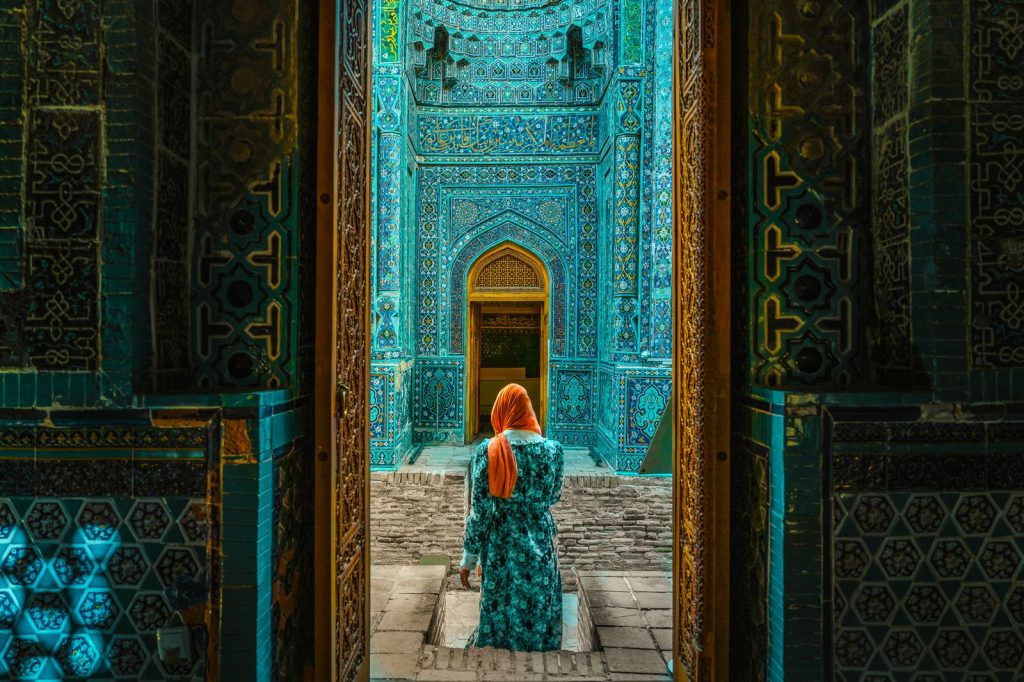
North east of Samarkand, Shah i Zinda offers a more intimate reading of Central Asia. Far from vast monumental squares, this necropolis reveals itself slowly, along a sacred corridor where architecture and spirituality move forward together. Between founding legends and masterpieces of Timurid art, the site tells a deeply human story, shaped by faith and time.
Article by Damien Lafon and Photographs by Quentin Tournier.
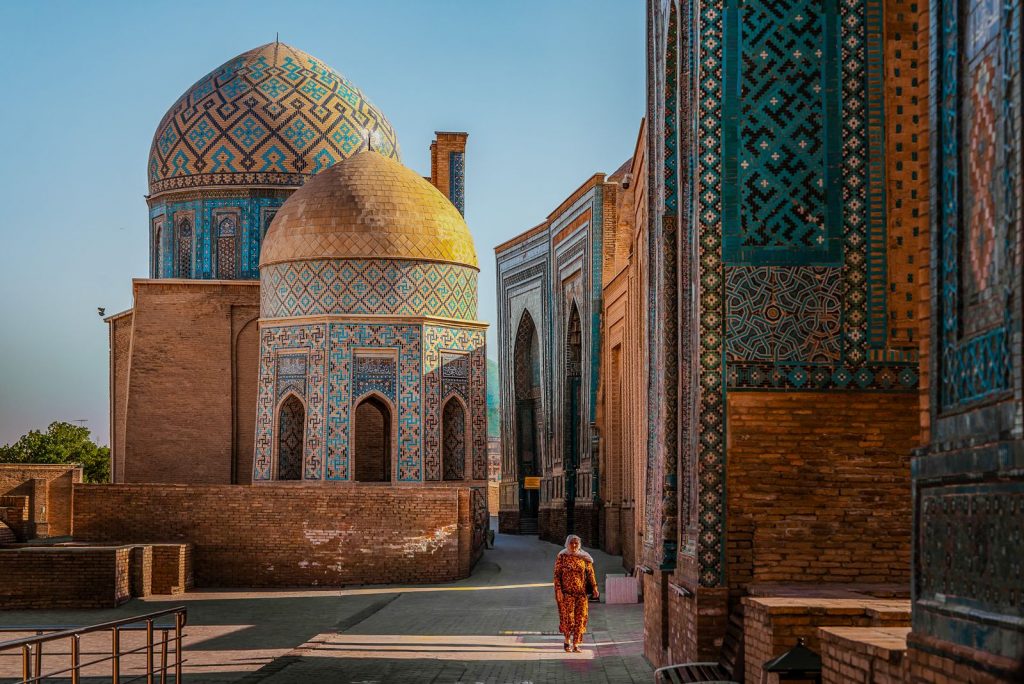
The sanctuary of mosaics, between faith, power, and Timurid heritage
North east of Samarkand, on a hill overlooking the old city, stands one of Uzbekistan’s most remarkable sites. The necropolis of Shah i Zinda forms a unique architectural ensemble, at once religious, political, and artistic. Unlike large monumental squares, this place requires a slow, almost introspective approach.
Shah i Zinda was not designed to impress at first glance. Visitors enter through a narrow passage that guides both movement and gaze. This gradual progression creates a direct relationship with space and symbolism. Here, architecture is never separated from spirituality. Every volume and every decorated surface contributes to a broader narrative. The site functions as an archive of stone and ceramic, transmitted across centuries.
A sacred place shaped by founding legends
According to local Islamic tradition, Shah i Zinda is believed to house the tomb of Qutham ibn Abbas, cousin of the Prophet Muhammad. He is said to have arrived in Central Asia during the seventh century to spread Islam throughout the region. His story remains inseparable from the sacred dimension of the site.
Legend, however, claims that he never truly died. Threatened, he is said to have taken refuge beneath the hill, where he still lives in an invisible world. This belief explains the name of the site, “the Living King,” and its lasting spiritual significance.
Very early on, Shah i Zinda became a major pilgrimage destination. Being buried near the presumed tomb of Qutham ibn Abbas was considered a spiritual privilege. This aspiration attracted nobles, dignitaries, and members of the ruling elite over the centuries. Even today, this religious dimension remains tangible. Residents of Samarkand continue to visit the site for quiet contemplation, far from purely touristic interest. As a result, the necropolis retains a living function, rare for such an ancient funerary complex.
A corridor of mausoleums at the heart of the journey
The spatial organization of Shah i Zinda is structured around a central corridor lined with mausoleums. This narrow passage defines the entire necropolis and imposes a linear reading of the site. Each mausoleum fits into a carefully designed visual continuity.
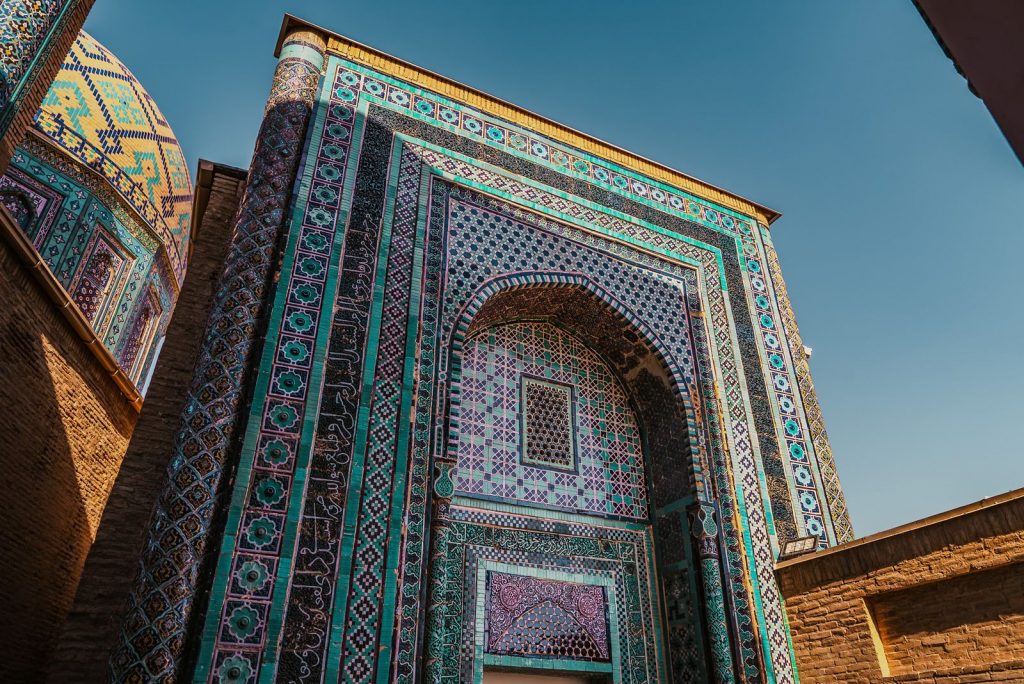
The façades display exceptional decorative richness. Glazed ceramic tiles, turquoise mosaics, cobalt blue, and deep green dominate the ensemble. Geometric and floral patterns interact with finely executed calligraphic inscriptions.
Each building nevertheless retains its own identity. Variations in form, color, and technique reflect different construction periods. Despite this diversity, the overall harmony remains striking, rarely matched in Central Asia. Light plays a crucial role in the perception of the site. Depending on the time of day, glazed surfaces absorb or reflect light differently. This constant variation gives the corridor a sense of permanent movement.
Did you know?
Artisans at Shah i Zinda used complex glazes requiring multiple firings, a highly advanced technique for the period.
The legacy of the Timurid dynasty
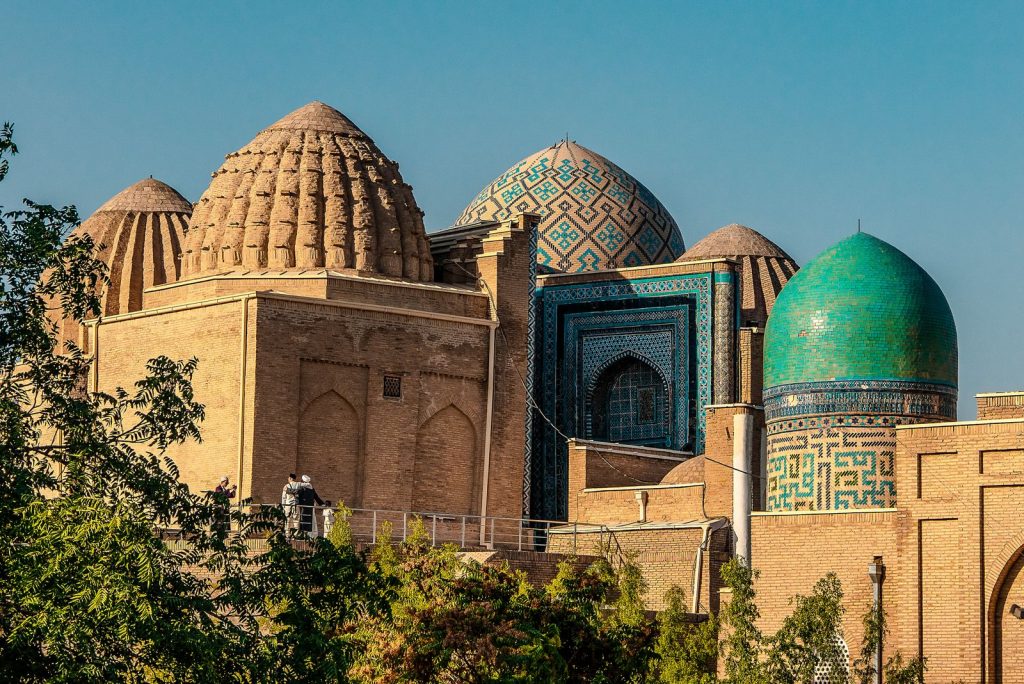
Most of the mausoleums visible today were built between the eleventh and fifteenth centuries. This period corresponds to the rise of the Timurid dynasty, founded by Tamerlane. Samarkand then became a major political, cultural, and scientific capital.
Shah i Zinda houses the tombs of court members, military leaders, and influential families. Each mausoleum reflects the social status of its occupant. The quality of decoration became a marker of power and prestige.
Timurid art reaches an exceptional level of mastery here. Architects worked with proportions, volumes, and colors with remarkable precision. The complexity of geometric patterns reflects advanced knowledge of mathematics and Islamic symbolism. For many historians, Shah i Zinda represents one of the most refined expressions of this artistic tradition. Some even consider the site more subtle than the famous Registan. The necropolis favors intimacy and depth over monumental scale.
Shah i Zinda and the Registan, two complementary visions
The Registan embodies the political and educational power of Samarkand. Its vast squares and monumental madrasas impress through scale and symmetry. Shah i Zinda offers a radically different experience.
Here, visitors move through a confined space. Proximity to the mausoleums heightens emotion and concentration. The experience becomes more personal, almost inward. This contrast explains why many travelers prefer Shah i Zinda. The site encourages a direct relationship with history and spirituality, offering a more nuanced understanding of Samarkand’s soul.
Did you know?
Decorative techniques developed at Shah i Zinda influenced Persian and Ottoman architecture for several centuries.
A living and preserved site
Despite its age, Shah i Zinda remains an active place of worship. This reality requires careful management between conservation and respect for religious practices. Restoration efforts aim to preserve authenticity without freezing the site in time. Uzbek and international experts regularly collaborate on conservation projects. Fragile mosaics, vulnerable to time and climate variations, require constant monitoring. These efforts ensure the transmission of this heritage to future generations.
For culturally minded travelers, Shah i Zinda represents an essential stop. The site highlights Samarkand’s central role along the Silk Road. It also illustrates the deep connection between spirituality, art, and power.
Why Shah i Zinda leaves a lasting impression
Shah i Zinda is not simply an accumulation of monuments. The site tells a continuous story shaped by faith and artistic creation. Every detail reflects a dialogue between humanity and the sacred.
Walking through the corridor gives the impression of crossing centuries. Different eras overlap without ever fully disappearing. This continuity creates a memorable experience, rare within world heritage. Visiting Shah i Zinda means accepting a slower pace and careful observation. It means understanding how architecture can convey universal spiritual values. Above all, it means discovering one of Central Asia’s most precious cultural ensembles.
Follow us on Instagram and Facebook to stay informed and support our media via www.helloasso.com
This article may interest you: Eagles of Kyrgyzstan: when the sky becomes a companion in the hunt