
Iceland is renowned for its breathtaking landscapes, active volcanoes, and expansive glaciers, With their colourful beaks and unmistakable appearance, Atlantic puffins are among the North Atlantic’s most recognisable seabirds. Yet behind their charming appearance lies an extraordinary ocean traveller, adapted to survive in some of Earth’s most demanding environments.but it Perched on the rugged cliffs of Iceland, puffins (Fratercula arctica) are iconic birds of the North Atlantic.

Iceland is renowned for its dramatic volcanic landscapes, glaciers and rugged coastlines. Every spring, millions of Atlantic puffins (Fratercula arctica) return to the island and other North Atlantic shores to breed. These remarkable seabirds spend most of their lives at sea, returning to land only for a few months each year. Their colourful appearance has made them a symbol of Icelandic wildlife, but their survival depends on increasingly fragile marine ecosystems.
Atlantic Puffins: Built for Life at Sea
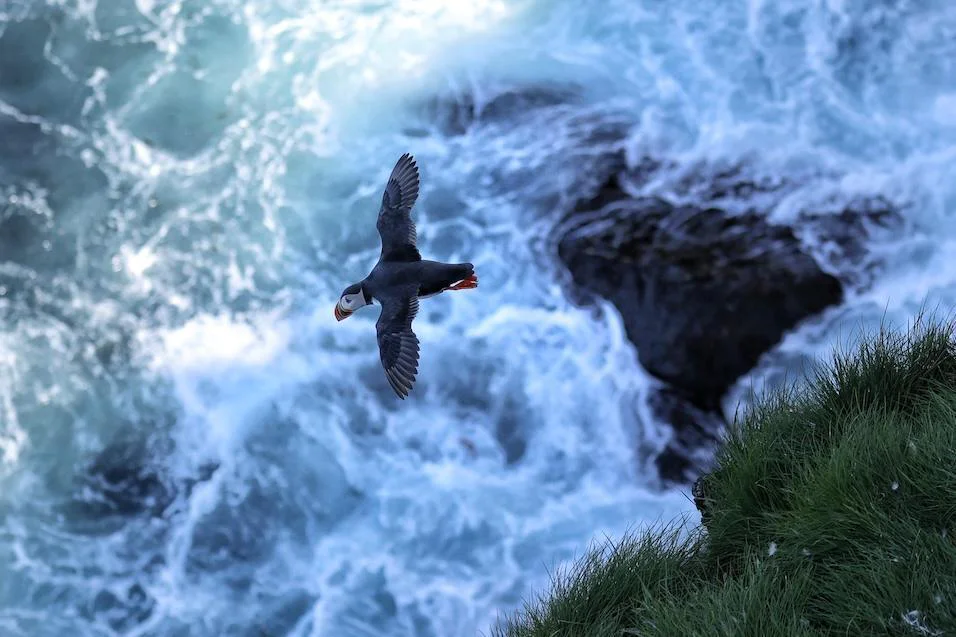
Atlantic puffins belong to the auk family, alongside guillemots and razorbills. Despite their resemblance to small penguins, they are capable of flight. Measuring approximately 26–30 centimetres in length, they have compact bodies, black-and-white plumage and distinctive triangular beaks. Their striking appearance has earned them the nickname “sea parrots”.
Their colourful beaks are particularly vibrant during the breeding season. After summer, puffins shed the outer ornamental plates, revealing smaller, duller bills. Their short, powerful wings serve two purposes: rapid flight above the ocean and efficient propulsion beneath its surface. Their dense, waterproof feathers help insulate them from the cold waters of the North Atlantic.
Atlantic puffins are extraordinary divers, capable of reaching depths approaching 60 metres, although most dives are shallower. Underwater, they use their wings like flippers while their feet provide steering. Their agility allows them to pursue small fish through the water with remarkable precision. These adaptations make them highly specialised marine predators.
Iceland: Home to the World’s Largest Puffin Colonies
Atlantic puffins breed across the North Atlantic, including Greenland, Norway, eastern Canada, Iceland and the British Isles. Iceland supports the world’s largest breeding population, making the species an important part of the country’s natural heritage. Its coastal cliffs and offshore islands provide suitable nesting habitats, particularly where grassy slopes allow birds to dig burrows.
Among the most important breeding areas are the Westman Islands (Vestmannaeyjar), a volcanic archipelago off Iceland’s southern coast. These islands support enormous seabird colonies, including Atlantic puffins that return each spring. On Heimaey and neighbouring islands, puffins gather along grassy cliffs, rocky slopes and coastal headlands. Their presence attracts researchers, photographers and wildlife enthusiasts.
During summer, thousands of puffins may occupy the same breeding landscape. Their burrows provide shelter from harsh weather and some predators, allowing them to raise their young in relative safety. Nevertheless, breeding success depends heavily on conditions offshore. Even when nesting habitats remain suitable, food shortages can significantly reduce the number of chicks that survive.
Remarkable Hunters of the North Atlantic
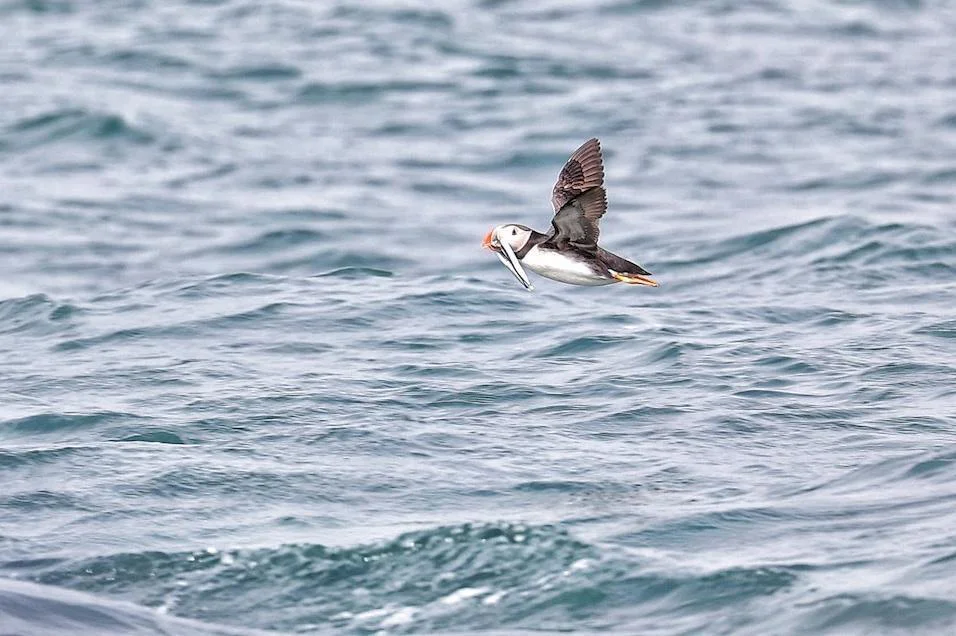
Atlantic puffins feed primarily on small schooling fish, including sandeels, herring, sprats and capelin. Their diet varies according to region, season and prey availability. During breeding, adults must catch enough fish to sustain themselves and feed their developing chicks. This makes nearby fishing grounds essential to the survival of entire colonies.
One of their most remarkable adaptations lies inside their beaks. Backward-pointing structures and a specialised tongue allow puffins to hold several fish simultaneously. They can therefore continue hunting without dropping their earlier catches. Images of puffins returning with rows of fish in their bills have become iconic representations of North Atlantic wildlife.
However, these feeding strategies depend on the availability of suitable prey. When fish populations decline or move into deeper, colder waters, adult puffins must travel farther to find food. Longer hunting trips consume additional energy and reduce the frequency of chick feeding. In some colonies, these changes have contributed to repeated breeding failures.
Did you know?
Atlantic puffins can carry multiple fish in their beaks during a single hunting trip. One exceptional bird was recorded carrying 83 sandeels, demonstrating the effectiveness of this specialised feeding adaptation.
Life Inside a Puffin Colony
Every spring, Atlantic puffins return to their traditional breeding grounds after spending months offshore. Many reunite with previous partners and occupy familiar nesting burrows. Puffins generally form long-term pair bonds, although partnerships can change between breeding seasons. Their courtship includes a distinctive behaviour known as “billing”, when two birds gently rub or tap their beaks together.
Unlike many seabirds that nest on exposed cliffs, puffins usually lay their eggs inside underground burrows or rocky crevices. Females typically produce a single egg each year, which both parents incubate for approximately six weeks. Once the chick hatches, the adults begin regular fishing trips to provide food. The young bird, commonly called a “puffling”, remains sheltered underground during its early development.
After approximately six weeks, depending on conditions, the puffling is ready to leave the nest. Young puffins often emerge at night before making their first journey towards the ocean. They must rapidly learn to survive independently, navigating unfamiliar waters and locating food. Several years may pass before they return to breeding colonies as adults.
Their relatively slow reproduction makes adult survival particularly important. Atlantic puffins generally begin breeding at around five years of age and usually raise only one chick annually. Although individuals can live for more than two decades, repeated breeding failures can have serious consequences for population stability.
The Mysterious Life of Puffins Beyond the Cliffs
When the breeding season ends, Atlantic puffins leave their nesting colonies and disperse across the North Atlantic. For much of the year, they remain at sea, travelling across extensive marine areas. Their winter movements were poorly understood for decades because observing individual birds across the open ocean is extremely difficult.
Modern tracking technologies have helped researchers uncover these remarkable journeys. Studies reveal that puffins from different breeding colonies may use different wintering areas. Some remain relatively close to northern waters, while others travel farther into the Atlantic. Their movements reflect changing food availability, ocean conditions and individual behaviour.
Life offshore exposes puffins to powerful storms, strong currents and unpredictable feeding conditions. During severe weather, they may struggle to locate sufficient food or maintain their energy reserves. Prolonged storms can occasionally cause large numbers of weakened seabirds to wash ashore, events known as seabird wrecks. These incidents demonstrate the vulnerability of even highly adapted ocean travellers.
Did you know?
Atlantic puffins spend most of their lives at sea and may remain away from breeding colonies for several years before reproducing. Their extraordinary movements help connect distant marine ecosystems across the North Atlantic.
Climate Change and the Future of Atlantic Puffins
Despite their widespread distribution, Atlantic puffins face growing environmental pressures. The International Union for Conservation of Nature (IUCN) classifies the species as Vulnerable globally. Population trends differ between regions, but significant declines have occurred in several breeding areas. Climate change, food shortages, extreme weather and human activities contribute to these challenges.
Rising ocean temperatures can alter the distribution and abundance of important prey species. Sandeels, a major food source for many puffin populations, are particularly sensitive to changes in marine ecosystems. When suitable fish become scarce near breeding colonies, adults must travel greater distances to feed their chicks. Reduced food delivery can affect chick growth and breeding success.
Industrial fishing can place additional pressure on marine food webs by removing forage fish that seabirds depend upon. In 2024, the United Kingdom introduced restrictions on industrial sandeel fishing in the English North Sea and Scottish waters. Such measures aim to protect the wider marine ecosystem and support seabird populations. Their long-term effectiveness requires continued monitoring and scientific assessment.
Iceland provides an important example of the challenges facing Atlantic puffins. In parts of the country, breeding success has fluctuated substantially, with warmer waters and changing prey availability contributing to difficult conditions. Research programmes monitor colonies, feeding patterns and population trends to better understand these changes. Protecting the species requires coordinated efforts across the North Atlantic.
Conservation initiatives also focus on breeding habitats, introduced predators and human disturbance. On some islands, removing invasive mammals has helped restore seabird populations. These successes demonstrate that targeted conservation measures can produce measurable improvements. Nevertheless, long-term recovery depends on protecting both nesting grounds and the ocean environments where puffins spend most of their lives.
Atlantic puffins are more than colourful symbols of Iceland’s natural heritage. They are skilled divers, long-distance travellers and important indicators of marine ecosystem health. Their future reflects the broader challenges facing seabirds in a rapidly changing ocean. Protecting them means preserving the delicate relationships that sustain life throughout the North Atlantic.
FAQ
Atlantic puffins are among Iceland’s most recognisable seabirds, admired for their colourful beaks and large breeding colonies. Their seasonal return to coastal cliffs has made them an important symbol of Icelandic wildlife and natural heritage.
Atlantic puffins primarily feed on small fish, including sandeels, herring, sprats and capelin. They use specialised structures inside their beaks to carry several fish simultaneously, particularly when feeding their chicks.
Atlantic puffins are classified as Vulnerable on the IUCN Red List. Climate change, declining fish availability, extreme weather, pollution and human activities threaten populations across parts of the North Atlantic.
Atlantic puffins commonly live for more than 20 years, and some individuals survive considerably longer. They generally begin reproducing around five years of age and typically produce only one chick per breeding season.
Follow us on Instagram and Facebook to stay informed
This article may be of interest to you: Why do seabirds travel so far to feed?