
Absent from scientific records for a long time, one of Indonesia’s rarest primates has been documented through years of rescue work. Its existence has now been confirmed, but what lies ahead for the species is still uncertain.
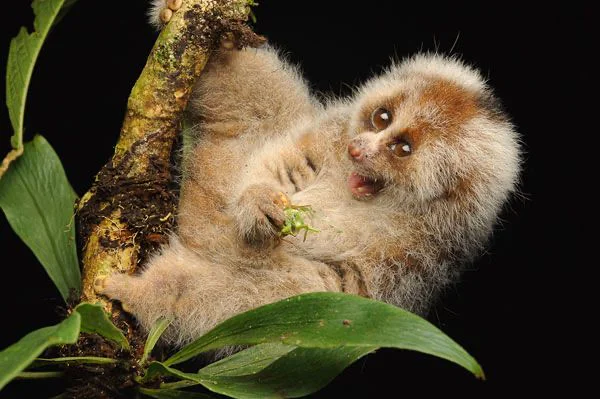
A small, nocturnal primate is showing up in odd places on the Indonesian island of Bangka. Residents have seen slow lorises in gardens, on roadsides and even perched on electricity cables. Some animals were hurt, others were held prisoner.
Local wildlife rescuers may have viewed these encounters as commonplace. Yet they involved a species that scientists had not formally documented in the literature for almost 90 years. The Bangka slow loris (Nycticebus bancanus) was listed as Critically Endangered and Possibly Extinct. A study published in October 2026 has now confirmed that it is still alive. The evidence did not come from a new expedition, but from more than a decade of rescue records gathered by an Indonesian conservation organisation.
A Species Not Recorded by Science
The Bangka slow loris was first described in 1906 from specimens collected on northern Bangka. Researchers regarded it as a subspecies of other slow lorises for most of the next century. It was officially classified as a separate species in 2013.
Its history remained remarkably meagre. The International Union for Conservation of Nature (IUCN) reported that the last known sighting occurred in 1937. Published research provided little evidence afterward, and so in 2020 the species was designated Critically Endangered (Possibly Extinct).
It was not in scientific publications, but that did not mean that no one had ever seen it. Local observations, photographs, and unpublished research already indicated the animal had survived. What was needed was a full scientific description. The evidence finally arrived from the Alobi Wildlife Rescue Center, located close to Pangkal Pinang, the capital city of Bangka Belitung province.
Over 90 Slow Lorises Saved
Between 2015 and August 2025, Alobi logged over 90 Bangka slow lorises on the island. Residents or local officials reported many of them through phone calls, messaging apps, and social media.
The rescue logs show the dangers that these animals face. Of the 43 individuals for whom we have detailed information, 16 were located in houses or gardens. Seven had electrical burns, six were found on roads and five came from captivity or the wildlife trade. Other animals were found on farms, either trapped in fences or killed by dogs. Rescue efforts were unsuccessful in saving at least three lives.
After treatment and recovery, 86 slow lorises were released across seven sites on Bangka Island. The organization chose sites where forest habitat persisted and where there was some degree of protection.
These records were the basis of a study published in the scientific journal Spixiana. Researchers from Alobi collaborated with colleagues from the Taman Safari Prigen Conservation Breeding Ark and the Haus des Meeres Aqua Terra Zoo in Vienna. The results showed that the species is distributed in several areas in Bangka. Rescue records were collected from four regencies and the city of Pangkal Pinang.
However, researchers caution against interpreting these numbers as evidence of a healthy population. No comprehensive census has established how many individuals remain in the wild.
A Small Primate With an Unusual Defence
The Bangka slow loris is easily recognised by its large, forward-facing eyes, reddish-brown fur and distinctive facial markings. It spends much of its life in trees, moving slowly through branches after dark.
Unlike monkeys that leap between trees, slow lorises rely on a powerful grip and deliberate movements. Their large eyes help them navigate low-light conditions, while specialised teeth assist with grooming and feeding.
They also possess a remarkable defence mechanism. Slow lorises are the only primates known to be venomous. A gland on the upper arm produces a secretion that becomes venomous when mixed with saliva. Their bite can cause considerable pain, swelling and potentially dangerous allergic reactions.
Scientists believe venom may play an important role in conflicts between slow lorises. Its precise functions, particularly in the Bangka species, remain poorly understood. Much of the animal’s ecology is still unknown. Researchers believe its diet resembles that of other slow lorises, including insects, tree gums and nectar.
An Island Transformed by Mining and Agriculture
Bangka lies off the southeastern coast of Sumatra and has long been associated with tin mining. Extraction has shaped the island’s economy and landscape for centuries. In recent decades, mining operations, agricultural development and expanding settlements have further altered its forests.
A study cited by the researchers estimated that the species’ forest habitat declined by 62% between 2000 and 2012. Large areas of natural vegetation have been replaced by mining sites, plantations and other disturbed landscapes. For a tree-dwelling primate, fragmented forests present serious challenges. Animals may have to cross roads or enter settlements to reach neighbouring vegetation. Electricity cables can become dangerous alternative routes.
The rescue records illustrate these risks. Several animals suffered serious burns after contact with power lines, while others were discovered far from suitable forest habitat. Their presence in residential areas does not necessarily suggest that slow lorises are adapting successfully to human development. It may also reflect the loss of places where they can live safely.
Wildlife trafficking creates additional pressure. Slow lorises are captured for the exotic pet trade in parts of Southeast Asia, although the scale of this threat on Bangka remains uncertain.
The Local Rescuers Behind the Rediscovery
One of the most revealing aspects of this story is how the evidence reached scientists. There was no dramatic encounter deep inside an unexplored rainforest. Instead, the discovery emerged from years of practical conservation work. Alobi’s staff responded to calls, collected injured animals, recorded their circumstances and returned survivors to suitable habitat.
Their observations eventually attracted the attention of international researchers. The resulting collaboration transformed local rescue records into published scientific evidence. Langka Sani, director of the Alobi Wildlife Rescue Center, has welcomed the recognition while warning that the species remains dangerously close to extinction. He identifies illegal tin mining and large-scale forest clearing for oil palm plantations as major threats.
The research also demonstrates why local conservation organisations matter. Their knowledge develops through repeated encounters with wildlife, often over many years. In Bangka, those encounters helped answer a scientific question that had remained unresolved for decades.
Rediscovery Does Not Mean Recovery
Confirming the Bangka slow loris is alive represents an important step. Yet the study leaves several questions unanswered. Researchers still need reliable population estimates, information about habitat connectivity and genetic evidence to clarify the species’ relationships with other slow lorises. The survival of released animals also requires closer monitoring.
The study recommends a coordinated conservation programme combining habitat protection, population surveys and carefully monitored releases. It also proposes a conservation breeding initiative to support future research and protection. These measures remain recommendations rather than evidence that the species is recovering. Much will depend on how effectively Bangka’s remaining natural forests can be protected.
The rediscovery has brought international attention to an animal largely overlooked by science. Whether that attention leads to lasting protection remains the more important question.
FAQ
Yes. The Bangka slow loris is listed as Critically Endangered, with an earlier IUCN assessment describing it as Possibly Extinct. Research published in October 2026 confirms its survival, but the wild population remains uncounted. Habitat destruction, electrical hazards and wildlife trafficking continue to threaten the species.
The species is associated primarily with Bangka Island, east of Sumatra in Indonesia. Its wider taxonomic distribution remains under investigation. It is nocturnal and spends much of its life in trees. Recent records document individuals across Bangka, including areas near settlements and plantations.
The species had been largely absent from formal scientific literature since the 1930s. Although local observations suggested it survived, researchers lacked a comprehensive published account. The 2026 study analysed more than 90 rescue records collected by Alobi between 2015 and 2025, confirming its continued presence on Bangka Island.
Follow us on Instagram and Facebook to stay informed
This article may be of interest to you: Bornean Orangutans: The Fight to Save a Disappearing Species