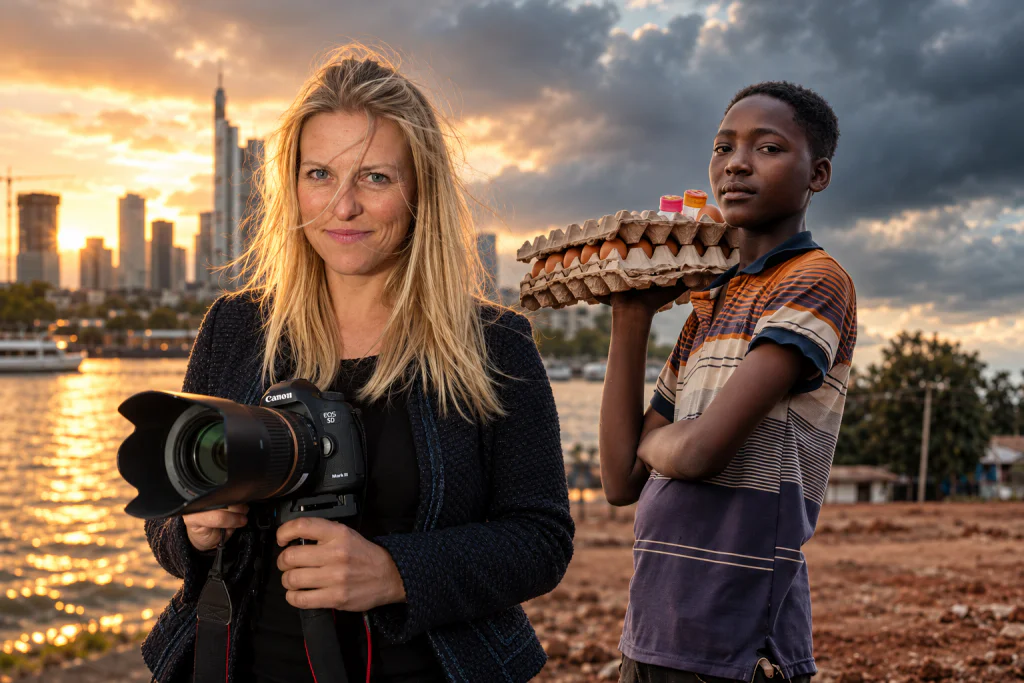
From the refugee routes of Europe to Roma communities in Slovakia and the aftermath of the devastating 2023 earthquake in Türkiye, German documentary photographer, journalist and filmmaker Manuela Federl has spent much of her career exploring stories of migration, inequality and human resilience. Her work goes beyond documenting difficult realities, seeking to understand the individuals behind them and the circumstances shaping their lives.
With more than fifteen years of experience in journalism and documentary filmmaking, Federl has developed a deeply personal approach to visual storytelling. Through projects such as 100 Hours of Lesbos, THE GAME and The Roma Princesses, she explores the relationship between photography, human dignity and social responsibility. For Terra Cultura, she reflects on the importance of trust, the ethics of representation and her belief that documentary photography can inspire understanding and meaningful change.

Your work often begins long before you take a photograph or switch on a camera. How important is research in your approach to documentary storytelling?
It depends on the story. Sometimes I research a subject very thoroughly before visiting a place. Other stories emerge while I am there, and sometimes, while taking photographs, I realise that a different story is actually the more important one to tell.
In my opinion, there is no fixed rule. Research helps me understand the context, the history and the people involved, but documentary work also requires an openness to the unexpected.
It is important to be well prepared, but once you are there, you have to rely above all on your instincts. Some of the most interesting stories are those you could never have anticipated before arriving.
Your interest in communities and cultural identity developed during your time with the Mapuche in Chile. How did that experience influence your journey as a journalist?
I have always been interested in people and their stories. Even at school, I used to write and take photographs for a local newspaper. I realised quite early that I wanted to become a journalist.
While studying at university in Chile, I learnt about the Mapuche people and their history. The subject immediately captivated me, and I wanted to understand more about their culture, their struggles and their everyday lives.
Thanks to a friend who had worked extensively with Mapuche communities, I was able to visit remote villages, experience rituals and witness preparations for large demonstrations. I spent time with people in their daily lives and even managed to learn a few words of Mapudungun, their language. Although, to be honest, I have forgotten them all again!
Unfortunately, I was not taking photographs at that time. I documented everything through writing instead. But the Mapuche remain very much on my photographic wish list.
Through documentaries such as THE GAME, you have spent extended periods with refugees along Europe’s borders. How do you build trust with people who have already experienced so much exposure?
THE GAME was probably the biggest and most important documentary I have ever made.
For a year and a half, I repeatedly visited the same locations along the Bosnian–Croatian border with a camera crew. We did not simply arrive, film and leave. We also brought food, baby supplies, medicines and clothing to people who were living in extremely difficult circumstances.
Over time, we got to know many of the refugees, some of whom had been stranded in Bosnia for several months. Gradually, relationships developed and friendships formed. They were no longer strangers in front of our cameras, and many wanted to share their journeys and experiences with us.
That is one reason why THE GAME became such a personal film.
I am delighted that it has been translated into five languages and screened in cinemas across different countries. German television has broadcast it several times, and it has also been made available on a streaming platform in Italy.
We developed educational materials for schools, too, and teachers have responded very positively.
It matters enormously to me that a documentary does not simply disappear after its first screening. I want these stories to continue reaching people and encouraging conversations. With THE GAME, I feel we have achieved that.

Where do you draw the line between documenting human suffering and becoming personally involved in the lives of the people you photograph?
It is a difficult question, because the longer you stay somewhere and the better you get to know people, the more your presence inevitably influences the situation.
I am still in regular contact with people from the Roma communities I have photographed. I have also returned to visit refugees I met while filming THE GAME.
But I think the relationship between the photographer and the subject depends very much on the project.
For example, my work on fast fashion focuses more on the wider issue than on individual personal stories. I do not become quite so deeply involved in people’s lives.
With the Roma communities and the refugees, it was different. We spent a great deal of time together, and personal relationships naturally developed.
I would not say that my boundaries have fundamentally changed over the years. You simply establish different relationships with different people, depending on the circumstances and the story you are telling.
Your photographs often portray people who are defined by labels such as ‘refugee’, ‘Roma’ or ‘victim’. How do you ensure their individuality remains visible?
As a matter of principle, I try to treat everyone equally, regardless of their background or circumstances.
For me, what matters is a person’s character and behaviour. I pay particular attention to how someone treats other people and animals.
Respect is something that has to be earned, and I do not distinguish between someone who is wealthy and someone who is living in poverty.
I think this attitude is important when working with people whose lives are often represented primarily through their difficulties.
Before anything else, they are individuals. Their circumstances are part of their story, but they should never be the only thing that defines them.
In The Roma Princesses, you chose to emphasise dignity, personality and beauty rather than conventional images of poverty. Why was that important to you?
In my photographs, it is important that people look beautiful and proud.
I never want to humiliate someone or deliberately portray them in a negative light, especially when photographing people living in poverty.
Nevertheless, it is always a fine line, and I have sometimes been criticised for my aesthetic approach to documentary photography.
In 2016, we were among the first to film the arrival of refugee boats on Lesbos in slow motion. Those images were extremely emotional, and I believe the technique allowed viewers to experience the moment more intensely.
The film received an award, but it also attracted considerable criticism.
I can accept that. I stand by my work because I would never deliberately expose anyone to ridicule.
For me, the important question is what you hope to achieve through an image or a film.
In that particular case, our intention was to document the situation of refugees in a way that might encourage people to help, or put pressure on politicians to bring about change.

After years working in film and television, what can documentary photography communicate that moving images sometimes cannot?
I often feel that people no longer watch films with their full attention. Perhaps they still do at the cinema, but when watching television or online content, it can be very different.
A powerful photograph, however, can still stop someone.
The viewer does not necessarily know the complete story behind the image. That uncertainty sparks their imagination, and the story begins to unfold in their mind.
Sometimes, I believe this can have a greater emotional impact than a documentary in which the narrative is presented more explicitly.
There is also a practical difference.
With films, I often experience the frustration of seeing a documentary broadcast once on television before disappearing into a channel’s archives.
With photographic essays, I can organise exhibitions, enter international photography competitions and offer stories to magazines around the world.
I feel that photography gives me greater control over how widely and for how long a story can be shared.
Some of your projects, including your work in Antakya following the 2023 earthquake, involve returning to the same places over time. Why is this continuity important?
I really enjoy returning to places I have already visited.
In both my documentary films and long-term photography projects, I want to go beyond the surface and explore a subject in greater depth.
That is very difficult to achieve during a first visit.
Initially, you are getting to know the location, understanding the situation, meeting people and identifying possible stories. You are also beginning to build trust.
When you return for the second time, things become easier. People recognise you, and you already have a better understanding of their environment.
By the third visit, I often find that I can take some really good photographs.
For me, returning is part of the process of developing a deeper understanding of the people and places I document.
You often wait until people stop consciously posing for the camera. How do you recognise the moment when someone finally becomes themselves?
I want people to take off their masks for my photographs.
We all put on a mask when someone points a camera at us. It is almost instinctive. We become aware of how we look and how we want to be seen.
So I continue taking photographs until I have the feeling: ‘That’s it!’
Sometimes that moment happens while we are still preparing for the photograph. At other times, it does not happen until the session is practically over.
I am a very open and outgoing person, and I have the impression that people generally find it easy to open up to me.
But I think the most important thing is that my interest in other people is genuine.
People can sense whether you are sincerely interested in them or simply trying to get a photograph.
After documenting migration, inequality and social exclusion for so many years, what continues to give you hope that visual storytelling can make a difference?
First of all, I am a die-hard optimist.
And secondly, I have seen time and again that my stories, whether through documentary photography or film, really can make a difference.
Through my work, I have helped raise money for refugees and Roma communities. Some people have become more understanding after seeing my photographs. Others have discovered, sometimes for the very first time, the difficult conditions in which certain Roma communities live.
These may seem like small changes, but they matter.
I love my work as a journalist. I live and breathe it, and I would not exchange it for anything in the world.
My friends sometimes describe me as a hopeless do-gooder.
But I genuinely believe that if everyone did just a little something for other people, or even for animals, the world would be a better place.
For my part, I simply try to do my bit.
Get in touch with Manuela: @manuelafederl
Follow us on Instagram and Facebook to stay informed
This article may be of interest to you: Stéphane Urbinati: When the Field Becomes the Teacher