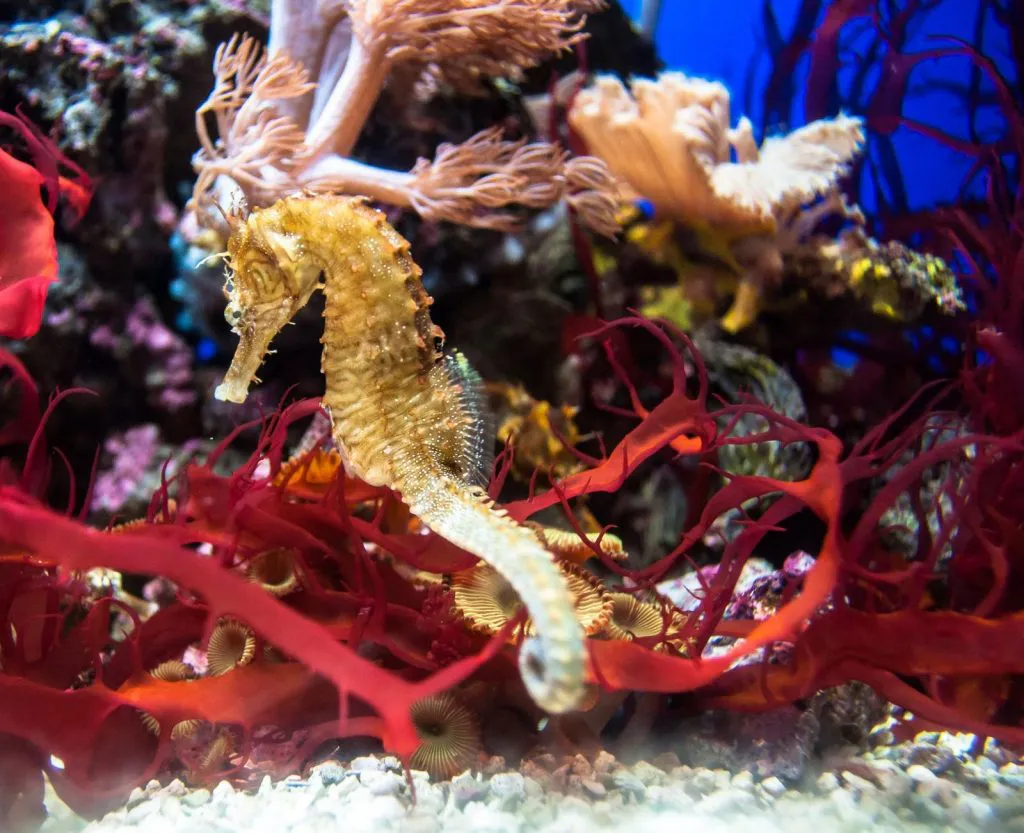
In southern Italy, scientists are testing artificial marine habitats to protect threatened seahorses. The project follows a population decline of around 90% in Taranto’s Mar Piccolo lagoon. Recent monitoring shows that both native species are using the new structures, offering a promising step towards conservation.
Once home to one of the Mediterranean’s largest seahorse populations, Mar Piccolo has become an important site for marine research. The shallow coastal lagoon supports diverse marine life, including two species of seahorses.
However, a sharp decline recorded from 2015 raised concerns about their future. Scientists have since examined the role of fishing pressure, illegal wildlife trade and environmental changes.
Today, researchers are exploring whether carefully designed artificial habitats can help these vulnerable animals survive.
Why Did Seahorse Populations Collapse?
Mar Piccolo supports two native species: the long-snouted seahorse (Hippocampus guttulatus) and the short-snouted seahorse (Hippocampus hippocampus).
Both rely on underwater vegetation and other structures for shelter. They use their tails to anchor themselves while feeding on small crustaceans.
A 2021 scientific study published in Frontiers in Marine Science documented a dramatic decline in seahorse density.
Researchers identified fishing activity and possible illegal collection as major concerns. Rising temperatures and habitat changes may also affect their survival.
The findings highlighted the need for stronger protection and long-term monitoring.
Artificial Seahorse Hotels Show Promising Results
In 2023, researchers launched the Seahorse Hotel project to create additional underwater refuges.
The initiative brings together the University of Bari, Italy’s National Research Council (CNR), One Ocean Foundation and other partners.
Scientists installed modular structures made from stone wool, a material commonly used in construction. Their design encourages marine organisms to settle and provides attachment points for seahorses.
According to One Ocean Foundation, underwater monitoring has recorded both seahorse species using these structures.
Further findings reported in 2026, based on monitoring through October 2025, confirmed that seahorses had increasingly occupied the artificial habitat.
These observations suggest that suitable structures can provide additional shelter in areas where natural habitat is under pressure.
Reintroductions Add Another Layer of Protection
Habitat restoration is not the only conservation measure underway.
Scientists have also developed a breeding and reintroduction programme with the Aquarium of Genoa.
More than 160 long-snouted seahorses were released during the programme’s first phase in 2024.
In May 2025, another 100 captive-bred short-snouted seahorses returned to the lagoon. More than 150 followed in October.
Before their release, researchers photographed each animal to support future identification and monitoring.
The Italian National Research Council says these efforts form part of a broader conservation strategy.
A Promising Experiment, Not Yet a Recovery
The results offer cautious optimism, but scientists have not established whether the wider seahorse populations are recovering.
Artificial habitats can provide shelter, while breeding programmes can reinforce depleted populations. Neither measure removes the threats these animals face.
Long-term protection will also require effective fishing controls, action against illegal wildlife trade and continued ecological monitoring.
For Taranto, the project offers a practical lesson in marine conservation: rebuilding suitable habitat may help threatened species, but lasting recovery depends on protecting the ecosystem around them.
Legend & Credit Photo Hero
Seahorses depend on underwater habitats for shelter and survival. Scientists in southern Italy are testing new conservation methods to protect declining populations./©️pexels.com
Follow us on Instagram and Facebook to stay informed
This article may be of interest to you: Can Artificial Intelligence Preserve a Tradition Without Changing It?