
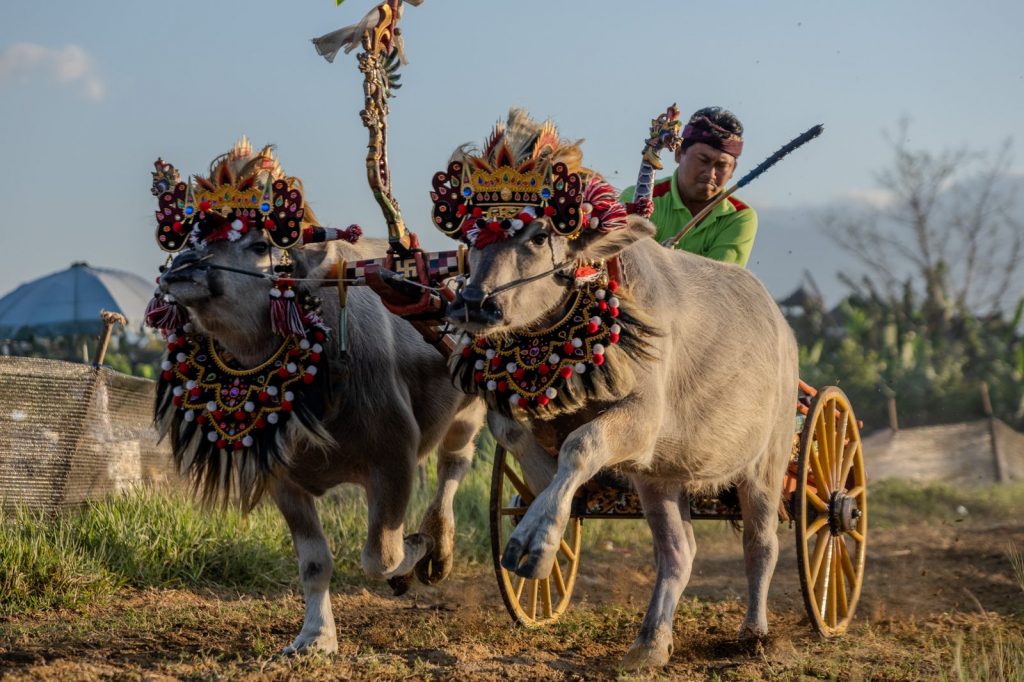
In western Bali, Makepung brings together hundreds of buffaloes racing at full speed along the tracks of Jembrana. Born in the rice fields, this tradition reflects the region’s agricultural history, rivalries and identity. Between competition, prestige and questions surrounding animal welfare, we explore a practice that remains deeply rooted in local life.
Article and photographs by Damien Lafon.
Makepung: The Origins of Jembrana’s Buffalo Races
In the far west of Bali, away from the tourist bustle of the island’s south, another side of Balinese culture comes to life. In Jembrana, rice fields, farming villages and long roads lined with coconut trees still shape a deeply rural landscape. This is where one of Bali’s most distinctive traditions was born: Makepung, a race in which pairs of buffaloes charge along dirt tracks. Behind them, a jockey stands on a small traditional cart, trying to maintain his balance at full speed.
Yet Makepung was not originally created as a spectacle. Its roots lie in the rice fields and in the daily lives of farmers who once relied on buffaloes to work the land. After completing their agricultural work, farmers began comparing the strength and speed of their animals. Gradually, these informal challenges developed into organised competitions. From the 1960s onwards, the tradition evolved further, moving from muddy rice fields to dirt tracks established around agricultural areas. Today, Makepung has become one of Jembrana’s cultural symbols and is recognised as part of Indonesia’s intangible cultural heritage.
From the Rice Fields to the Racetrack
The word Makepung is generally associated with the idea of chasing or pursuing someone. This notion remains clearly visible in the way the competition works today. Two historic teams divide Jembrana along the Ijo Gading River, which crosses the Negara area. The Blok Barat, on the western side, is traditionally associated with green. The Blok Timur, to the east, is represented by red. However, the races do not work exactly like conventional horse racing.
Competitors start with an initial gap, traditionally around ten metres. If the leading team maintains or increases its advantage, it wins the duel. However, if the team behind manages to reduce the distance sufficiently, it can be declared the winner. Speed alone is therefore not enough. Acceleration, the jockey’s control and the ability of the pair to maintain their pace are all essential. The buffaloes are also divided into several categories according to their performance. The fastest compete in Class A, followed by Classes B and C, with additional categories for slower or less experienced animals.
Did you know?
Two colours divide Makepung. The Ijo Gading River historically separates competitors into two main groups. The west wears green, while the east is represented by red.
Hundreds of Buffaloes and a Full Racing Season
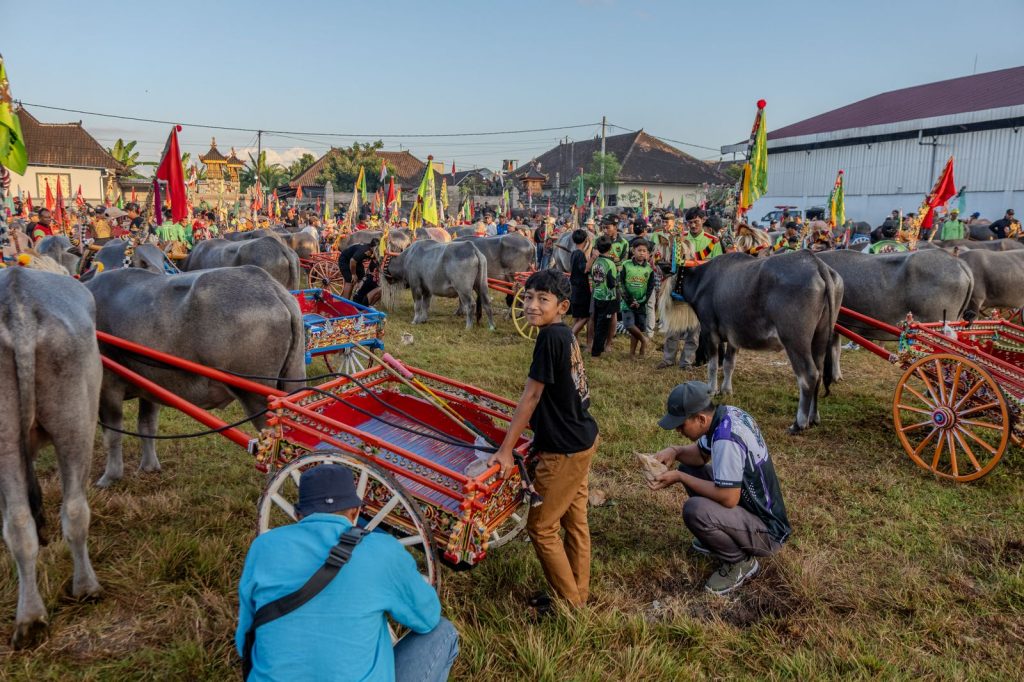
Today, Makepung is organised around a racing season. Traditionally, several meetings take place between the middle of the year and November, including major competitions such as the Bupati Cup and Governor Cup. The numbers give an idea of the scale of these events. During the final round of the 2025 Jembrana Cup, 244 pairs of buffaloes competed: 133 representing the western bloc and 111 representing the eastern bloc. In June 2026, the Kapolda Cup in Pengambengan brought together 254 pairs, including 132 from Blok Barat and 122 from Blok Timur. That represents more than 500 buffaloes at a single competition.
According to local authorities, the event also attracted around 2,000 participants and spectators. Some previous editions have announced as many as 500 pairs competing across different categories. Makepung therefore extends far beyond a simple village pastime. Owners, families, jockeys, breeders and supporters all participate in a competition where allegiance to each bloc remains significant. Success can also considerably increase the value of a winning pair. Some sources have reported that high-performing pairs can reach around IDR 175 million. Indonesian authorities have also mentioned values reaching several hundred million rupiah for successful animals. These figures vary considerably and should not be considered official market prices.
Buffaloes Prepared Like Athletes
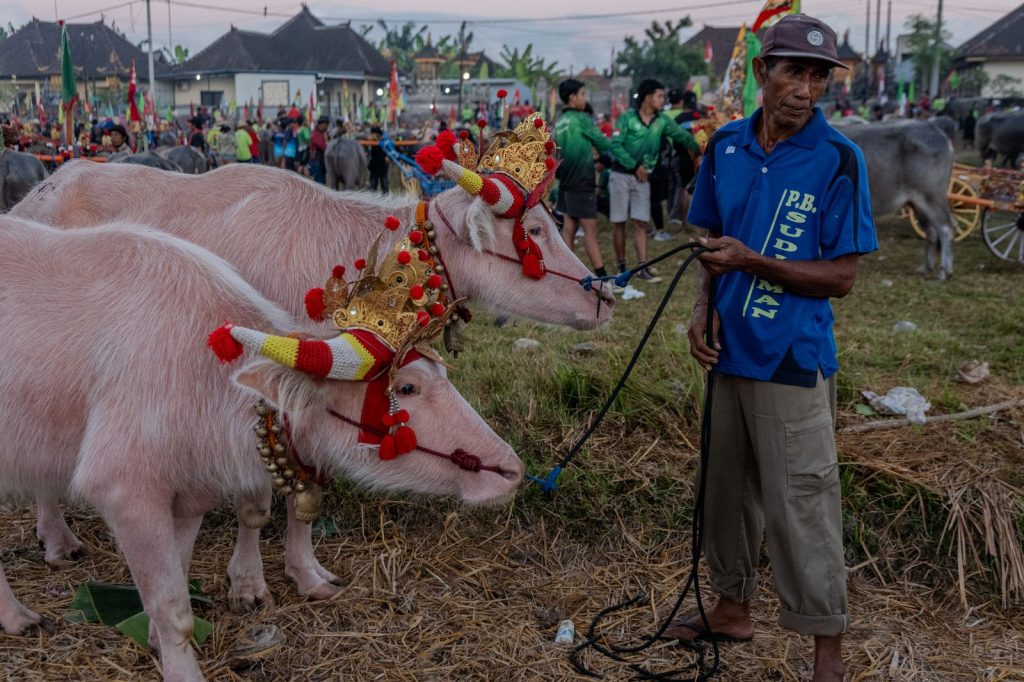
Long before race day, Makepung begins in the villages. Buffaloes selected for racing often receive particular attention regarding their diet, training and physical condition. Some owners supplement their food with traditional preparations and additional nutrients intended to maintain their condition. The animals are also trained regularly before major competitions. On race day, they become central figures in a carefully prepared visual display. Their heads are decorated, their horns highlighted and their equipment carries the colours of their teams. The small cart, known as a cikar, is also decorated.
The jockey then takes his position behind the two animals on an extremely light structure, with very little protection. At high speed, a small difference in trajectory or a sudden movement can result in a serious fall. Makepung therefore also carries risks for the jockeys. Behind the competition, however, lies an economic and everyday relationship between owners and their animals. For many rural families, maintaining a competitive pair requires considerable time, money and care. Winning brings a prize, but above all community recognition. Several accounts place greater emphasis on the prestige of victory than on the financial reward itself.
Did you know?
Winning can significantly increase the value of a pair of buffaloes. Well-known racing pairs have been valued at around IDR 175 million, sometimes more depending on their performance and reputation.
A Tradition That Also Raises Questions About Animal Welfare
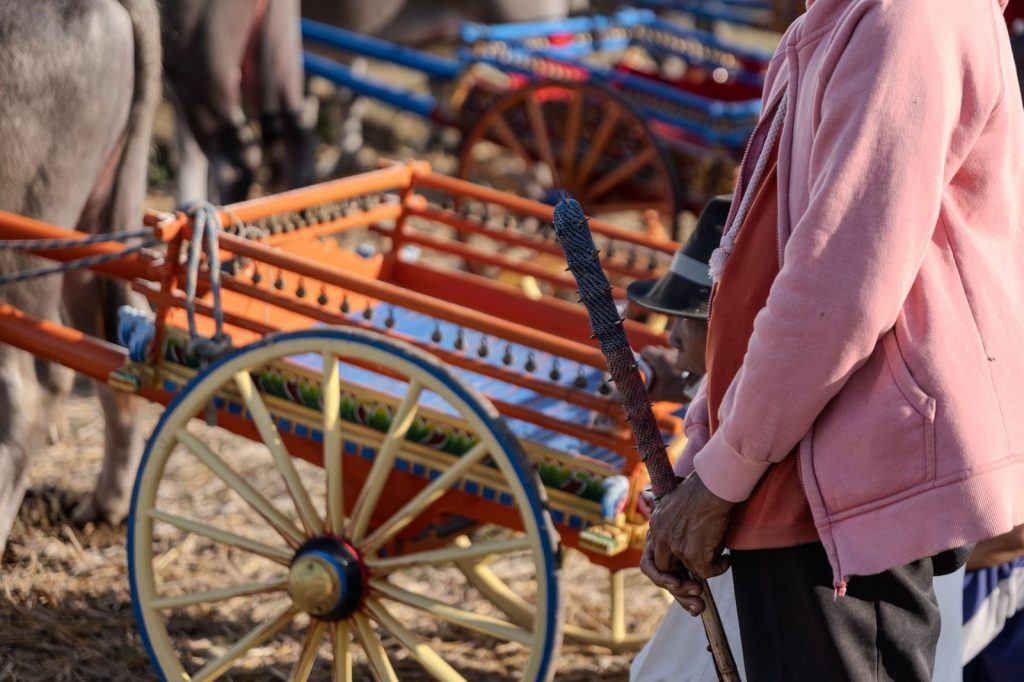
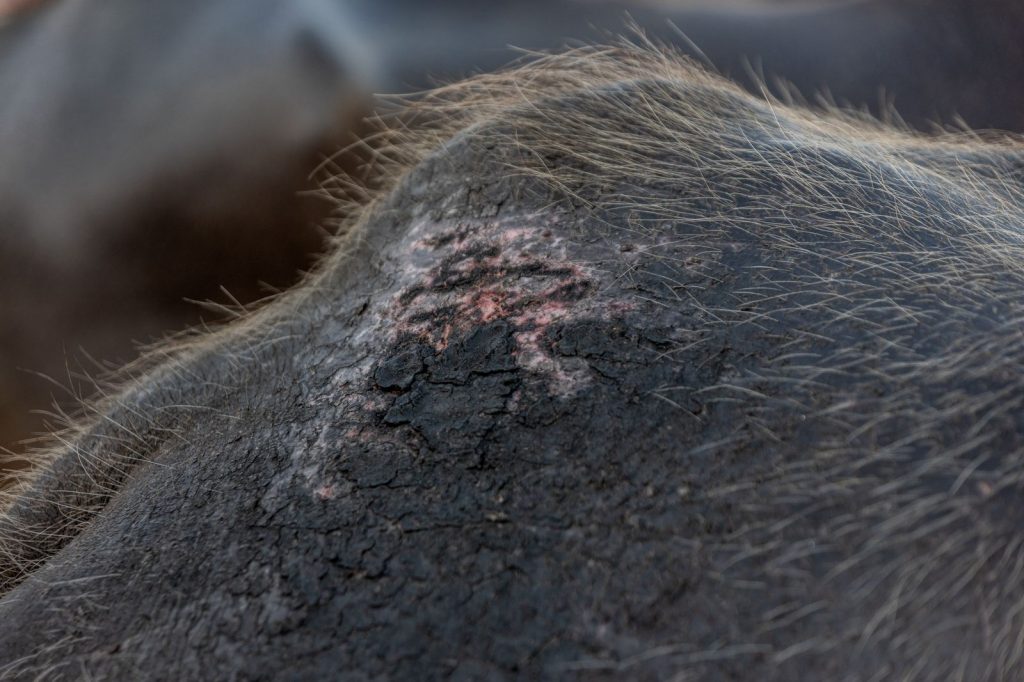
Observing Makepung also means confronting a more uncomfortable aspect of the tradition. To encourage the buffaloes to accelerate, jockeys have traditionally used whips or sticks. Some historical practices are more difficult to view through contemporary perspectives on animal welfare. Several Indonesian documents and studies on Makepung describe the use of a bongkol, a stick fitted with small spikes or nails. Jockeys used it on the rear of the buffaloes to make them accelerate, sometimes leaving visible wounds and blood after a race. Unsurprisingly, this practice has attracted criticism, particularly from some foreign visitors.
However, reducing Makepung to this single aspect would provide an incomplete picture. Owners devote considerable time and resources to their animals, while local authorities have begun changing certain practices. At events held at the All In One circuit in Pengambengan, pointed sticks have notably been replaced with whips in an effort to prevent visible injuries. Makepung therefore faces a question shared by many traditions involving animals: how can cultural heritage be preserved while practices that have become increasingly difficult to accept are allowed to evolve? The answer belongs first to the communities that continue to keep the tradition alive. Its evolution nevertheless demonstrates that a culture can remain alive precisely because it is capable of change.
More Than a Race
When the buffaloes disappear into a cloud of dust, Makepung ultimately reveals something larger than competition. It tells the agricultural story of Jembrana, when buffaloes provided essential power for working the rice fields. It also reflects the rivalry between two territories divided by the Ijo Gading River. Red and green continue to compete today, while several generations gather around the racetracks. Jegog, Jembrana’s distinctive traditional music, also accompanies some major events and reinforces this sense of collective identity. Yet Makepung also reflects Bali’s transformation. Agricultural mechanisation has gradually replaced some of the work once performed by buffaloes.
Tourism has changed the way the races are perceived. Meanwhile, concerns surrounding animal welfare are introducing new limits and encouraging changes in practice. Nevertheless, hundreds of pairs continue to participate in major competitions. In 2026, more than 250 pairs were present at a single major event. This continuity helps explain why Makepung remains so closely associated with Jembrana. It is neither a frozen tradition nor simply a spectacle created for visitors. It is a rural practice that became a competition, a form of heritage and a regional symbol. A tradition that can be visually striking and at times confronting, but one that also reveals a region searching for balance between heritage and change.
FAQ
Makepung takes place in Jembrana Regency, in western Bali, on several racetracks around Negara and the surrounding villages.
The main season generally runs from the middle of the year until November, with several race meetings and major finals.
The number varies depending on the event. The Kapolda Cup in June 2026 featured 254 pairs, representing 508 competing buffaloes.
The practice is historically documented. However, some competitions have begun replacing these sticks with whips intended to cause less injury.
Because it brings together agriculture, family history, territorial rivalry, buffalo breeding and local identity. Victory continues to carry considerable prestige within the community.
Follow us on Instagram and Facebook to stay informed
This article may be of interest to you: Why Water Buffaloes Are Slowly Disappearing From Asian Rice Fields