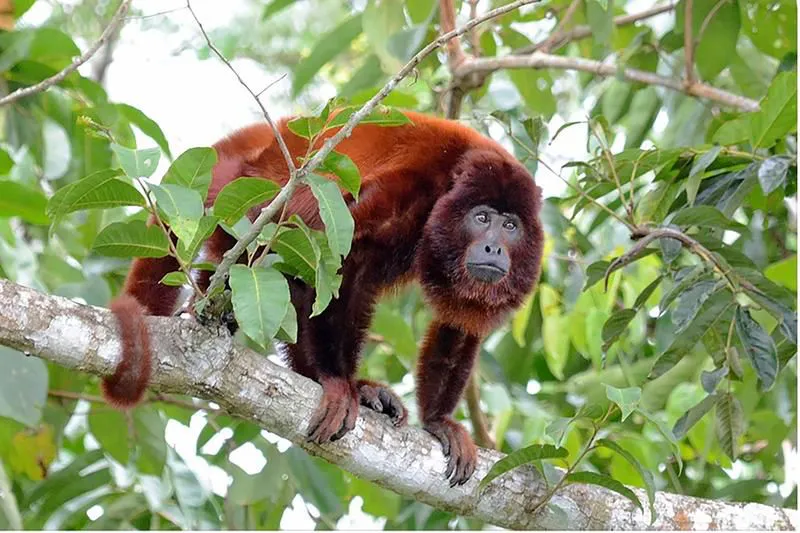
Scientists have identified two new species of howler monkeys in the Amazon rainforest. But one may already face a serious risk of extinction as deforestation continues to destroy its habitat.
The Amazon rainforest still holds remarkable secrets. Scientists have identified two previously unrecognised species of howler monkeys, revealing hidden biodiversity in the world’s largest tropical rainforest. The discovery, published on October 30, 2026, in the scientific journal Communications Biology, follows years of genetic research across South America.
The two species, Alouatta iroi and Alouatta matogrossensis, were previously grouped with other red howler monkeys. DNA analysis and physical evidence have now confirmed that they are distinct species. Yet the findings raise an important question: how many animals remain unknown to science while their habitats continue to disappear?
Two New Monkey Species Hidden in the Amazon
Researchers from the University of Salford and international partners examined genetic data from 11 howler monkey species. They compared DNA with physical characteristics, including specimens preserved in natural history museums.
The results revealed two distinct species. The Pantepui red howler monkey (Alouatta iroi) lives in northwestern Amazonia. The Mato Grosso red howler monkey (Alouatta matogrossensis) inhabits the southern Brazilian Amazon.
Scientists had known about these monkeys for years. However, they had not recognised them as separate species. The discovery shows how modern genetics can reveal biodiversity that has remained hidden in plain sight.
How Amazon Rivers Created New Species
Howler monkeys are famous for their powerful calls, which can travel across large areas of tropical forest.
But their evolutionary history is equally remarkable. Researchers found that major rivers, including the Amazon, Rio Branco and Xingu, helped separate monkey populations over long periods. These natural barriers prevented populations from mixing freely. Over time, the isolated groups developed distinct genetic characteristics.
The scientific study suggests that much of the diversity among Amazonian howler monkeys emerged during the past million years. It also highlights how rivers have shaped the evolution of wildlife across South America.
Could One New Monkey Species Already Be Endangered?
For one newly identified species, recognition may have come at a critical moment. The Mato Grosso red howler lives in southern Amazonia, where agricultural expansion, deforestation and habitat fragmentation have transformed large areas of forest.
As Mongabay reported, researchers believe this species could qualify as critically endangered. However, a formal conservation assessment is still needed. There is also encouraging news. In Brazil, the Reconecta Project has installed canopy bridges that help monkeys and other tree-dwelling animals cross roads safely.
Researchers have already recorded Mato Grosso red howlers using these crossings, including a female carrying her infant.
How Much of the Amazon Remains Unknown?
The discovery highlights a wider challenge for conservation. Protecting wildlife depends on knowing which species exist, where they live and what threatens them. The Amazon continues to reveal unexpected biological diversity. Yet deforestation is changing the same habitats scientists are still trying to understand.
For these two howler monkeys, scientific recognition could mark the beginning of stronger conservation efforts.
Legend & Credit Photo Hero
The newly described Mato Grosso red howler monkey (Alouatta matogrossensis), found in the Brazilian Amazon. Photo: ©️ Bruno Rennó.
Follow us on Instagram and Facebook to stay informed
This article may be of interest to you: Why Do Tropical Rainforests Host So Many Species?