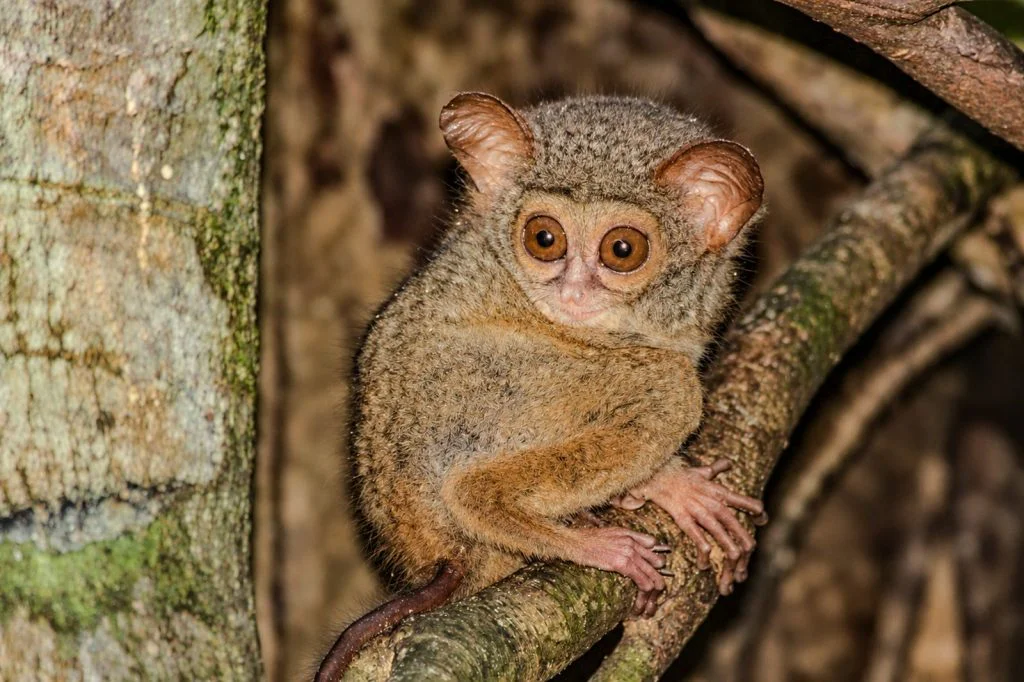
From the forests of Borneo to the islands of Sulawesi and the Philippines, tarsiers are among Asia’s most unusual primates. Their enormous eyes, powerful hind legs, and nocturnal hunting abilities reveal remarkable evolutionary adaptations. Yet these small predators face increasing pressure from habitat destruction and human activity.
What Makes Tarsiers So Extraordinary?
Hidden in the forests of Southeast Asia, tarsiers are among the most unusual primates on Earth. These small animals live in Borneo, Sumatra, Sulawesi and parts of the Philippines. Although they share distant ancestors with monkeys, apes and humans, they have developed remarkable ways to survive.
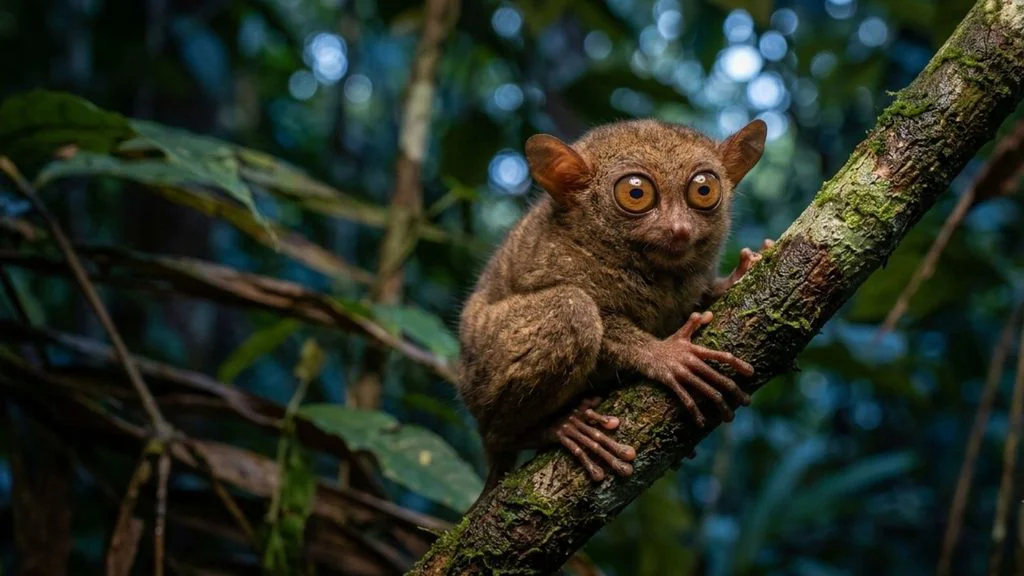
Their bodies are small, but their eyes are enormous. They also have long tails, powerful legs and fingers built for gripping branches. Together, these features help them move through dense forests and hunt after dark.
Their eyes are perhaps their most striking feature. Each can measure around 15 to 18 millimetres across, depending on the species. Compared with their body size, tarsiers have some of the largest eyes of any mammal.
These large eyes help them gather light in the dark forest. However, unlike many other night animals, tarsiers lack a reflective layer behind the retina, known as the tapetum lucidum. Instead, they rely on their large eyes and special features of the retina to see in low light.
Their eyes can barely move inside their sockets. As a result, tarsiers must turn their heads to look around. They can rotate their heads almost 180 degrees in either direction, helping them spot prey without moving their bodies.
These unusual traits make tarsiers highly skilled hunters in the darkness of tropical forests.
Built for Life Between the Trees
A tarsier’s name comes from the long bones in its feet, known as tarsal bones. These help give the animal its remarkable jumping ability.
Rather than moving mainly along branches like many other primates, tarsiers often cling to upright tree trunks. They then leap from one trunk or stem to another, sometimes covering several metres in a single jump.
Their powerful hind legs provide the force needed to leap. Meanwhile, long fingers and toes help them grip the next branch or trunk. Small pads at the tips improve their hold, while their tails help maintain balance.
This way of moving is known as vertical clinging and leaping.
These skills allow tarsiers to move through thick forest vegetation. Some species also live in secondary forests, dense shrubs and areas where trees are beginning to grow back.
However, not every forest offers the same conditions. Tarsiers need suitable places to rest during the day, enough prey to hunt and vegetation that allows them to move safely.
Studies in Indonesia show that their movements depend on forest structure, food and local conditions.
As a result, protecting tarsiers means more than saving a few trees. It also means keeping the vegetation between their resting and feeding areas connected.
How Tarsiers Hunt in the Dark
Tarsiers have an unusual diet for primates. Unlike monkeys and apes that often eat fruit or leaves, tarsiers feed only on other animals.
Insects make up much of their food. However, they also hunt spiders and, depending on the species, small frogs, lizards and other animals.
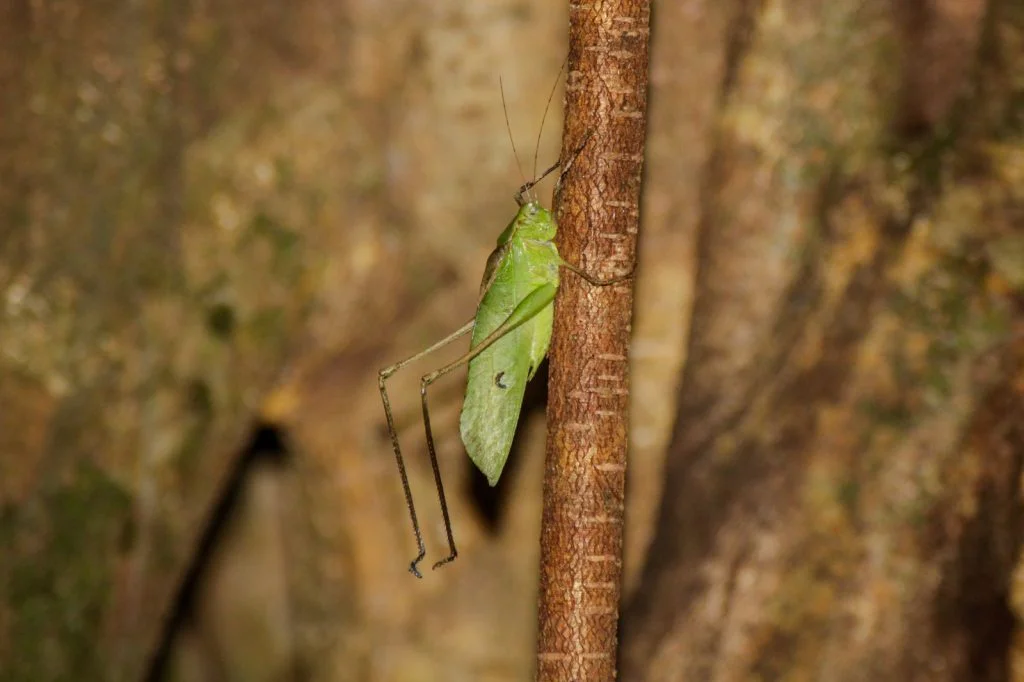
Studies of Bornean tarsiers have recorded a wide range of prey, including beetles and grasshoppers. In Sulawesi, tarsiers often feed on crickets, moths and spiders.
Their hunting skills depend on more than eyesight.
Large eyes help them detect movement in dim light. Meanwhile, their sensitive ears allow them to hear insects and other prey nearby.
Once a tarsier spots its target, it can leap with surprising speed. Its strong hind legs and gripping fingers allow it to move between branches and catch prey.
These small hunters also play a role in the wider forest ecosystem. By eating insects and other animals, they form part of the natural food web.
Their survival therefore depends on both healthy vegetation and a steady supply of prey.
Did You Know?
The Philippine tarsier (Carlito syrichta) can hear frequencies up to approximately 91 kHz, far beyond human hearing. A 2012 study also recorded ultrasonic calls at around 70 kHz, suggesting these primates may communicate without being detected by some predators. Source: Ramsier et al. (2012), Biology Letters.
The Secret Social Lives of Tarsiers
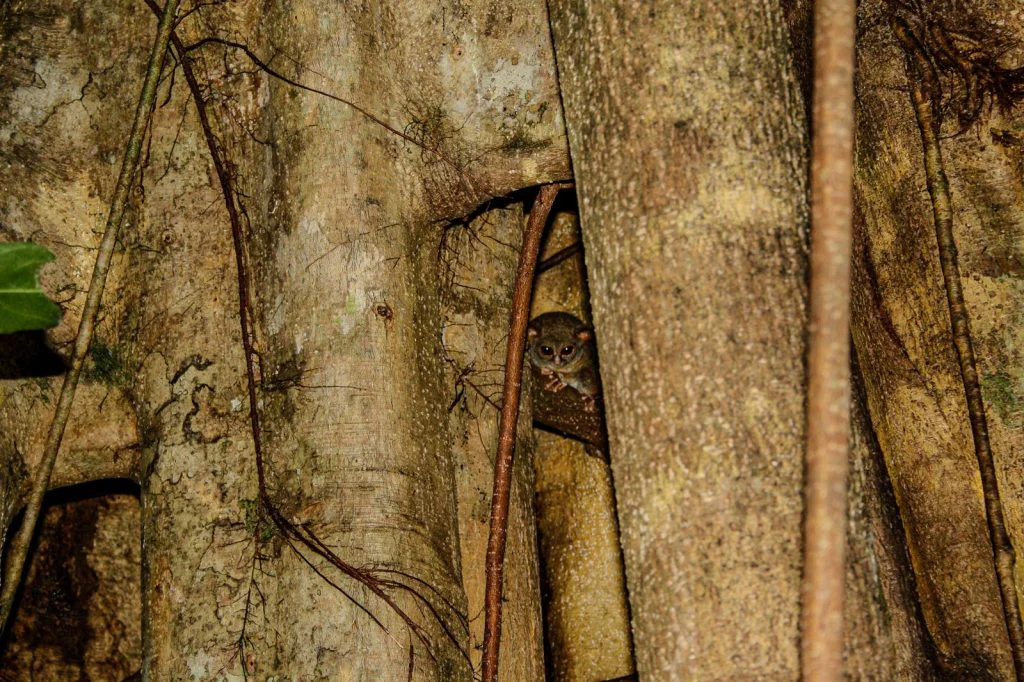
Tarsiers may look alike, but they do not all live in the same way. Some species form small family groups, while others spend much of their time alone. Their social lives depend on where they live and how they interact with other tarsiers.
In Sulawesi, scientists have found that some tarsiers live in groups and use calls to stay in touch. These sounds can also warn other groups that a territory is occupied.
Some species even perform duets. Around sunrise, a male and female may call back and forth from the same sleeping area. These calls help them maintain social bonds and defend their territory.
A study of spectral tarsiers in Sulawesi found that these small primates interact with one another during the night. They also share sleeping sites during the day. Source: American Journal of Primatology
However, not all tarsiers behave this way. Other species show different patterns of social contact and may spend more time alone.
Their behaviour can also change with local conditions. The number of animals in an area, the forest structure and the places available for sleeping all play a role.
As a result, scientists cannot describe every tarsier species as solitary or living in pairs.
These differences matter for conservation. Protecting tarsiers means providing enough suitable habitat for each species to feed, rest and maintain its natural social life.
Where Do Tarsiers Live in Southeast Asia?
Tarsiers live only in parts of Southeast Asia. Today, they are found in Indonesia, Malaysia, Brunei and the Philippines.
Indonesia is home to several species, many of which live nowhere else on Earth. Borneo supports different tarsiers from those found on Sulawesi and its nearby islands.
Over millions of years, the sea has kept many of these populations apart. As a result, they have followed different paths of evolution.
Sulawesi is especially important. Its forests are home to several tarsier species, some with very small ranges.
Scientists continue to study these animals and the differences between local populations. New research helps reveal how many species exist and where each one lives.
However, tarsiers do not all depend on untouched forests.
Some species can survive in secondary forests, thick shrubs and landscapes changed by human activity. These areas may still offer food, shelter and places to sleep.
Yet their survival depends on the right conditions. They need vegetation that allows them to move, safe resting sites and enough insects and other prey.
This makes protecting their habitats more complex than saving one large forest.
A protected area in Borneo cannot help a species found only on Sulawesi. Each species faces different threats and needs protection suited to its own environment.
Why Are Tarsiers Threatened?
For many tarsiers, the loss of forest habitat is a serious threat.
Across Southeast Asia, forests continue to change as land is cleared for farming, roads and other developments. As a result, tarsiers may lose the trees and thick vegetation they need for shelter, hunting and movement.
Forest loss can also leave small groups cut off from one another. When suitable habitats become isolated, animals may find it harder to move between feeding areas or reach other populations.
However, not all tarsier species face the same level of danger.
According to the IUCN Red List, Jatna’s tarsier (Tarsius supriatnai) is classified as Vulnerable. This species lives in Sulawesi, where forest loss and changes in land use threaten parts of its habitat.
Source: IUCN Red List — Jatna’s Tarsier
The Siau Island tarsier (Tarsius tumpara) faces an even greater risk. It lives only on Siau, a small island north of Sulawesi.
The IUCN lists this species as Critically Endangered. Because it has such a limited range, damage to its habitat can affect a large share of its population.
Source: IUCN Red List — Siau Island Tarsier
The wildlife trade adds another concern. Some tarsiers are taken from the wild and kept in captivity.
Yet these animals have very specific needs. They depend on live prey, suitable shelter and conditions that support their natural behaviour. Without proper care, captivity can place their health and survival at risk.
Protecting tarsiers therefore requires more than preventing forest loss. It also means keeping habitats connected, reducing disturbance and protecting wild populations from capture.
Did You Know?
Tarsiers are not a single species, and their conservation status varies across Southeast Asia. Some species remain relatively widespread, while others occupy very small geographical areas. The Siau Island tarsier is classified as Critically Endangered, making it one of the most threatened members of the group. This distinction highlights the importance of species-specific conservation assessments rather than treating all tarsiers as equally endangered.
Can Conservation Protect These Nocturnal Primates?
Protecting tarsiers begins with saving the forests they depend on. These habitats provide food, safe places to sleep and trees they need to move through the night.
Forest reserves and national parks can help protect these areas. However, each tarsier species has different needs. A forest that suits one species may not offer the right conditions for another.
In Sulawesi, protected forests provide important shelter for several tarsier species. Scientists also study where these animals live, how they use their habitats and which threats they face.
This research helps guide conservation efforts, both inside and outside protected areas.
Wildlife tourism can also raise awareness when visitors respect the animals and their natural behaviour. Tarsiers are small, sensitive creatures that spend much of the day resting.
As a result, visitors should keep a safe distance and never try to touch or handle them. Flash photography and bright lights directed at the animals should also be avoided. Local guides and park rules can help ensure that visits cause as little disturbance as possible.
Yet protecting tarsiers means more than saving individual animals. Their future depends on healthy forests, connected habitats and enough natural prey to survive.
These remarkable primates have spent millions of years adapting to life in the dark.
Their survival now depends on the future of the forests they call home.
FAQ
No. Tarsiers belong to the order Primates, but they are not monkeys. They form a distinct evolutionary lineage within the haplorhine primates, which also include monkeys, apes, and humans.
Their unusually large eyes collect available light, supporting vision in dark forest environments. Because their eyes have limited movement, tarsiers rely heavily on head rotation.
Tarsiers feed exclusively on animal prey. Their diet includes insects and spiders, while some species also capture small vertebrates.
Wild tarsiers occur in parts of Southeast Asia, including Borneo, Sumatra, Sulawesi, and several Philippine islands. Different species occupy different geographical ranges.
No. Conservation status varies by species. Some are classified as Vulnerable, while the Siau Island tarsier is Critically Endangered. Habitat loss remains an important threat to several populations.
Credit photo: WildlifeOfIndonesia.
Sources & References
- Collins, Hendrickson & Kaas (2005). Overview of the visual system of Tarsius. https://pubmed.ncbi.nlm.nih.gov/16200648/
- Ramsier et al. (2012). Primate communication in the pure ultrasound. Biology Letters. https://pubmed.ncbi.nlm.nih.gov/22319094/
- Wisconsin National Primate Research Center. Tarsier Factsheet. https://primate.wisc.edu/primate-info-net/pin-factsheets/pin-factsheet-tarsier/
- IUCN Red List of Threatened Species. Species assessments for Tarsius tumpara and other Southeast Asian tarsiers. https://www.iucnredlist.org/
- American Society of Mammalogists. Mammal Diversity Database. https://www.mammaldiversity.org/
Follow us on Instagram and Facebook to stay informed
This article may be of interest to you: The Silver Langur: A Primate Adapted to the Mangroves of Asia