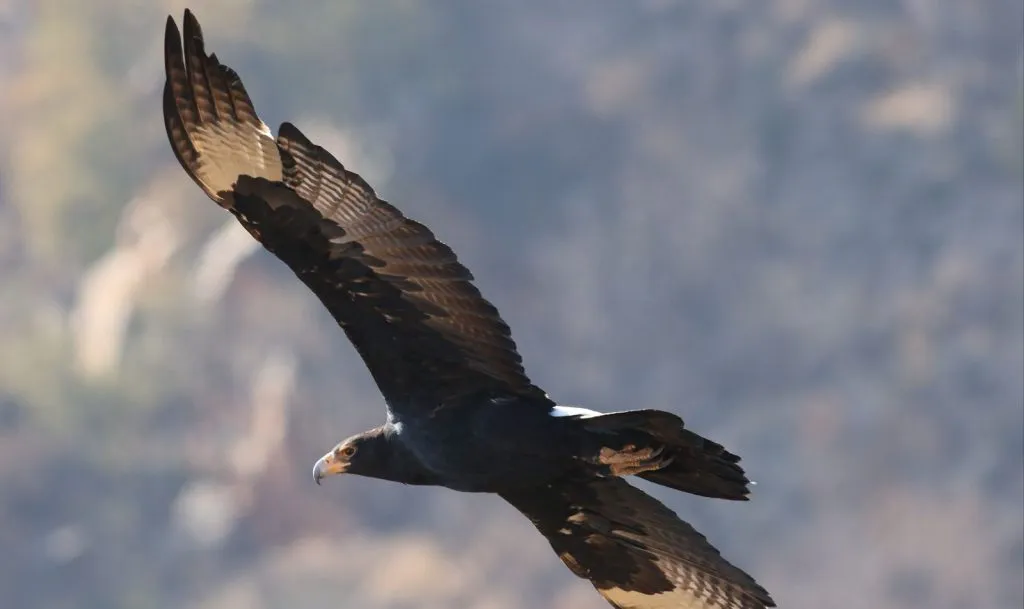
Scientists working in the Sahara Desert have uncovered evidence suggesting that Verreaux’s eagles can hunt adult baboons weighing over 26 kilograms. Published on November 18, 2026, the study challenges previous assumptions about birds of prey and raises new questions about human evolution.
An Unexpected Discovery in the Sahara
In northern Chad, the Ennedi Plateau is home to an isolated population of olive baboons (Papio anubis). These primates live among sandstone cliffs, deep canyons and scattered water sources.
During an expedition in 2025, researchers studying these monkeys made an unexpected discovery. Several bones and skulls showed unusual damage.
Small holes in the skulls and deep scratches on shoulder bones pointed towards an unlikely predator. The prime suspect was Verreaux’s eagle (Aquila verreauxii), a large African bird of prey.
Until now, scientists had never confirmed eagle predation on a primate weighing more than 13 kilograms. However, the discoveries in Chad suggest that the upper limit could be much higher.
A Predator Capable of Taking Much Larger Prey
The international research team returned to the region in June 2026. There, scientists discovered the partial skeleton of another adult male baboon. Based on bone measurements, they estimated that the animal weighed 26.2 kilograms. Once again, its remains showed injuries consistent with the sharp talons of a large eagle.
Although the researchers did not witness a fatal attack, the bone damage strongly supports the possibility of active hunting. However, they cannot entirely rule out the possibility that eagles fed on animals that were already dead. The findings therefore offer compelling evidence rather than direct proof of a kill.
Why Baboons Fear These Eagles
The team also noticed something remarkable about the behaviour of living baboons. When a pair of Verreaux’s eagles appeared, the monkeys immediately sounded alarm calls and moved towards safer areas.
Other large birds of prey did not trigger the same reaction. The rocky landscape may help explain this behaviour. While cliffs provide shelter from predators on the ground, exposed ledges can leave baboons vulnerable to attacks from above. Moreover, an eagle does not necessarily need to carry its prey away to feed on it.
What This Could Mean for Human Evolution
The discovery reaches far beyond the cliffs of Chad. Several early human species had body weights similar to those of adult male olive baboons. As a result, large eagles may also have posed a threat to some of our ancestors.
Such dangers could have influenced the development of alarm calls, group protection and social cooperation. However, further research is needed to explore this possible link. For now, the isolated baboons of the Ennedi Plateau offer a fascinating glimpse into the complex relationship between predators and primates.
They also remind us that even familiar animals can still challenge our understanding of the natural world.
Sources: American Journal of Biological Anthropology https://dmscdn.vuelio.co.uk/publicitem/9435335e-58d4-4d3b-bbe2-f5386c451cff
Legend & Credit Photo Hero
A Verreaux’s eagle (Aquila verreauxii) in flight over South Africa. New research in Chad suggests that this powerful African raptor may be capable of hunting adult baboons weighing over 26 kilograms. Photo: ©️Derek Keats / Wikimedia Commons / CC BY 2.0.
Follow us on Instagram and Facebook to stay informed
This article may be of interest to you: Coral Bleaching Recovery: A New Discovery Offers Hope