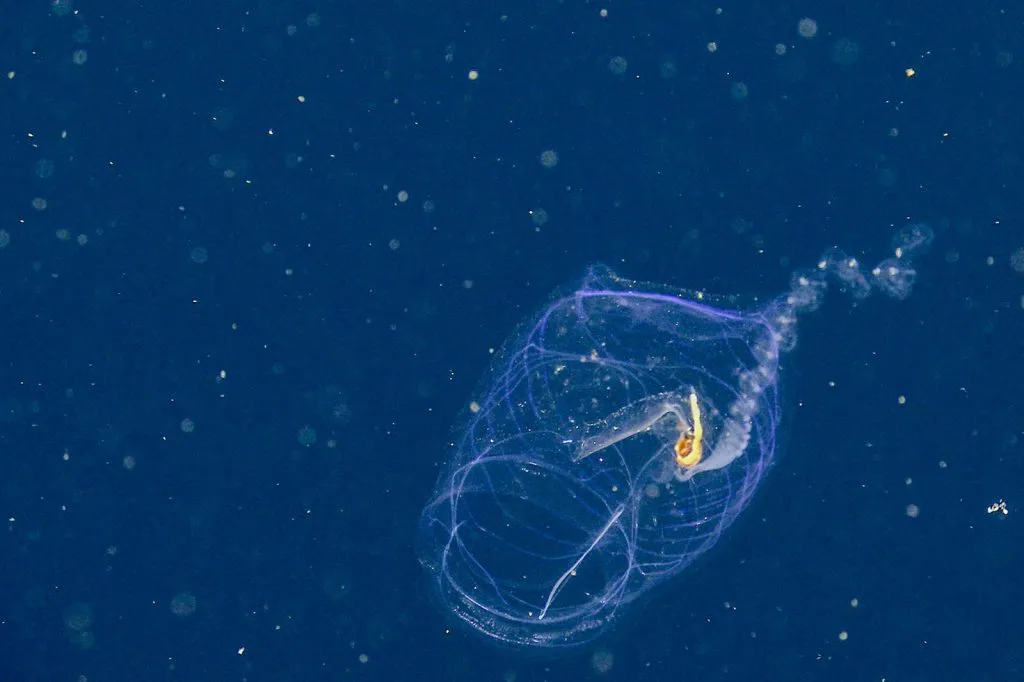
Scientists have identified a remarkable transparent animal living up to 2,200 meters beneath the ocean’s surface. Known as the glass salp, this unusual species offers a fascinating glimpse into a world that remains largely unexplored.
Far below the ocean’s surface, where sunlight fades and darkness takes over, life takes extraordinary forms. Some creatures produce their own light, while others have bodies that are almost invisible.
On November 24, 2026, the Monterey Bay Aquarium Research Institute (MBARI) revealed details about a remarkable deep-sea animal. Named Vitreosalpa gemini, this transparent creature belongs to a group of marine animals known as salps. However, unlike its relatives, the glass salp appears to spend its entire life in the deep ocean.
A discovery more than 20 years in the making
Researchers first encountered this unusual animal in the waters of Monterey Bay, California, more than two decades ago. Yet studying such a fragile creature proved challenging. Its soft body makes collection difficult. Furthermore, its remote habitat limits opportunities for direct observation.
To overcome these challenges, scientists used underwater robots equipped with cameras and sampling tools. Over the years, researchers documented the animal across several regions of the eastern Pacific.
Marine biologist Laurence P. Madin formally described the animal in the scientific journal Marine Biodiversity. Published on September 17, 2026, his research established both a new species and a new genus. The scientific name refers to its glass-like appearance and its unusual ability to produce twin embryos.
Life in the ocean’s darkest waters
The glass salp inhabits waters between 280 and 2,200 meters below the surface. This remarkable range extends across two distinct ocean environments.
According to NOAA Ocean Exploration, the twilight zone begins around 200 meters deep. Here, sunlight becomes too weak to support photosynthesis. Below 1,000 meters lies the midnight zone, where sunlight never reaches.
Food is often scarce, while temperatures remain low. Animals must also cope with intense pressure. Despite these harsh conditions, the deep ocean supports an extraordinary variety of life. Its inhabitants have developed different ways to find food, reproduce and survive.
For the glass salp, slow movement and low energy needs appear to be part of the solution.
A transparent animal with unusual abilities
Although salps resemble jellyfish, they belong to a different group of animals called tunicates. Surprisingly, these creatures are among our closest invertebrate relatives.
Most salps feed near the ocean’s surface, where microscopic organisms are abundant. As explained by the Woods Hole Oceanographic Institution, they filter seawater to capture tiny food particles.
The glass salp, however, lives far below these productive waters. Instead, it feeds on organic particles and single-celled organisms found at depth.
It also displays an unusual reproductive strategy. Salps can alternate between living alone and forming chains of genetically identical individuals. Researchers have observed glass salp chains containing up to 20 individuals. Producing twin embryos may also help the species reproduce in an environment where individuals are widely scattered.
Small creatures with a global impact
Despite their fragile appearance, salps can play an important role in marine ecosystems. Many species consume microscopic organisms near the ocean’s surface. They then release waste particles that sink into deeper waters.
These particles carry carbon from the upper ocean into the depths. Scientists call this natural process the biological carbon pump.
Dead salps can also sink, carrying additional organic material toward the seabed. As a result, these often-overlooked animals contribute to the movement of carbon through the ocean. However, scientists still need to determine the specific contribution of the glass salp to this global process.
An ocean still full of mysteries
The discovery of Vitreosalpa gemini comes at a time when interest in the deep ocean is growing. New technologies allow scientists to observe animals that were once almost impossible to study. Underwater robots can now document delicate organisms without removing them from their natural environment.
These observations are particularly valuable as climate change and potential deep-sea mining raise concerns about poorly understood ecosystems. Understanding what lives in the deep ocean is an essential step toward protecting it.
The glass salp offers a simple reminder. Even after centuries of ocean exploration, entire branches of marine life remain poorly documented. And somewhere beneath the waves, other extraordinary creatures are still waiting to be discovered.
Legend & Credit Photo Hero
A transparent glass salp (Vitreosalpa gemini), the first known salp species to live exclusively in the deep ocean. ©️ 2022 MBARI.
Follow us on Instagram and Facebook to stay informed
This article may be of interest to you: New Flying Frog in Sulawesi Lays Its Eggs in Jelly